

How To De-Escalate An Argument: 8 Therapist-Backed Tips
Learning how to de-escalate an argument is one of the most valuable communication skills you can develop. Whether you're navigating conflict with a partner, family member, friend, or coworker, these therapist-backed strategies can help prevent disagreements from escalating and damaging your relationships.
The good news? De-escalation is a learnable skill. You don't have to be naturally calm or conflict-averse to get better at it. With the right techniques, you can interrupt the cycle of reactivity, bring down the emotional temperature, and create space for real conversation. These aren't abstract theories; they're practical tools that therapists use and teach every day.
At Breath of Hope Professional Counseling, our clinicians help individuals and couples in San Antonio and across Texas navigate conflict more effectively. Drawing from evidence-based approaches like the Gottman Method, we've seen firsthand how small shifts in communication can transform relationships.
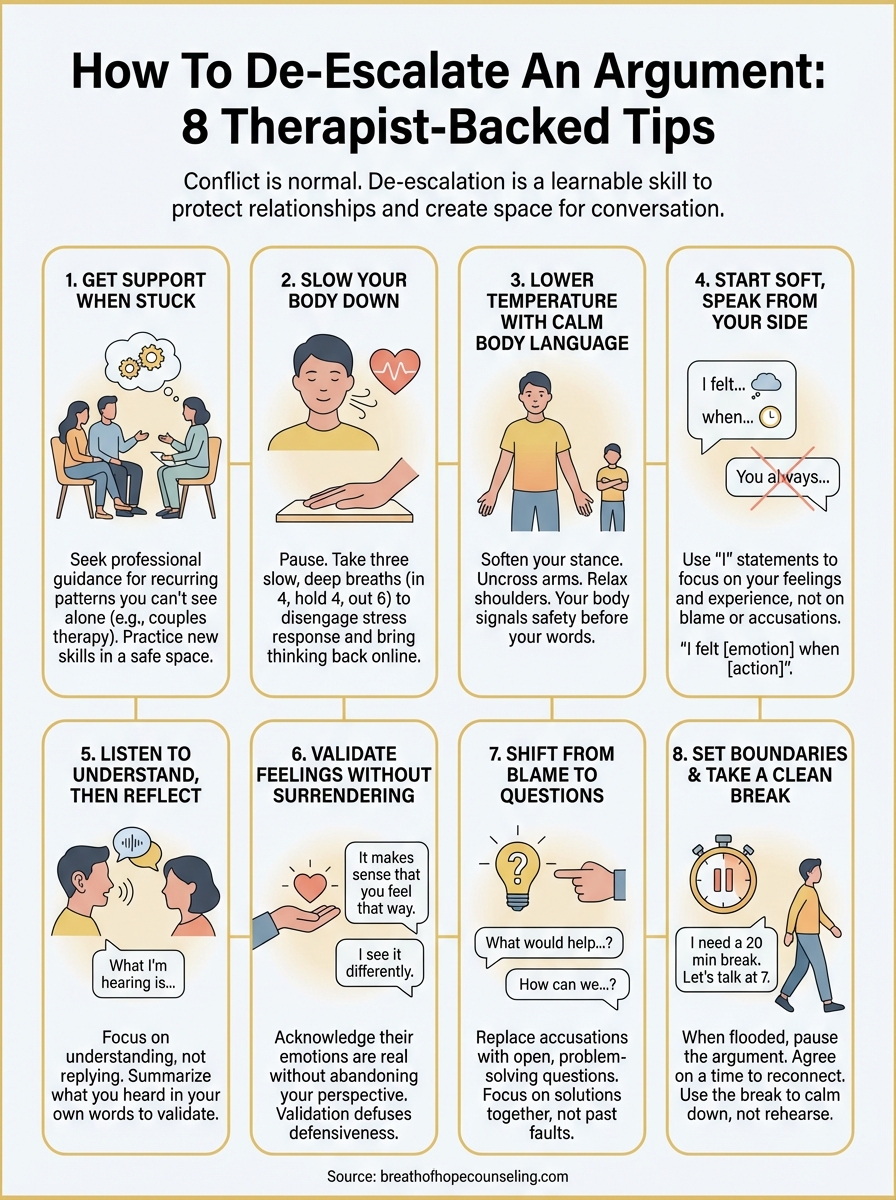
In this guide, we're sharing How To De-Escalate An Argument: 8 Therapist-Backed Tips that can help you stay grounded, communicate more effectively, and steer disagreements toward resolution. Whether you're in the middle of a heated conversation or looking to prevent future conflicts, these practical strategies can help you respond with greater calm, clarity, and confidence.
1. Get support when arguments keep escalating
If you find yourself stuck in the same fights over and over, or if arguments escalate no matter what you try, the most powerful step isn't something you do during the conflict itself. It's getting professional support outside of it. Couples therapy or individual counseling gives you tools, perspective, and patterns you can't see on your own. When you learn how to de-escalate an argument with trained guidance, you stop relying on instinct alone and start building skills that actually work.
-
Arguments that keep escalating usually follow predictable patterns that neither person recognizes in the moment. A therapist helps you map those patterns and understand what triggers them. You might discover that your partner's withdrawal makes you pursue harder, or that your tone shifts without you noticing. These insights don't come from willpower; they come from having someone outside the relationship point out what you can't see when emotions are high.
Therapy also gives you a safe container to practice new responses. You learn techniques like taking timeouts, using repair attempts, and managing physiological arousal. When both people commit to the process, you build a shared language for conflict that makes de-escalation feel less like damage control and more like teamwork.
Professional support doesn't mean your relationship is failing. It means you're serious about making it work.
-
While therapy happens outside the argument, you can apply what you learn in real time. If you've been working with a counselor, you might pause mid-conflict and say, "This feels like that pattern we talked about." That acknowledgment alone can shift the energy. You're signaling that you see what's happening and you want to change it.
Another in-the-moment strategy is to reference your shared goals from therapy. Reminding yourself and your partner that you're both working toward better communication can create just enough space to step back before things spiral.
-
"I think we're stuck in that cycle again. Can we take a breath?"
"I want to handle this differently than we usually do. Let's slow down."
"We said we'd try pausing when it gets heated. I need that right now."
2. Slow your body down before you respond
When an argument heats up, your body reacts faster than your brain. Your heart rate spikes, your breathing gets shallow, and your nervous system shifts into fight-or-flight mode. In that state, you're biologically primed to defend, not to listen or problem-solve. Learning how to de-escalate an argument starts with recognizing that your body is running the show, and you need to interrupt that response before you say something you'll regret.

-
Your body and mind are connected through your nervous system. When you feel attacked or criticized, your amygdala activates and floods your system with stress hormones. This reaction happens in milliseconds, long before your thinking brain can catch up. That's why you might snap back or shut down without meaning to.
Slowing your body down disengages that stress response. Deep breathing, pausing, or grounding techniques signal to your nervous system that you're safe. Once your physiology calms, your prefrontal cortex comes back online, and you can access empathy, perspective, and better judgment.
When your body is calm, your words follow.
-
The simplest tool is your breath. Take three slow, deep breaths before you respond. Breathe in through your nose for four counts, hold for four, and exhale for six. This activates your parasympathetic nervous system, which counteracts the stress response.
You can also ground yourself physically. Press your feet into the floor, feel the weight of your body, or clench and release your fists. These actions bring you back into your body and out of reactive thinking.
-
"Hold on, I need a second to breathe."
"I'm feeling too worked up to talk clearly. Give me a minute."
"Let me slow down before I respond to that."
3. Lower the temperature with calm body language
Your words aren't the only thing speaking during an argument. Your posture, facial expressions, and physical presence send signals that either escalate tension or invite resolution. When you learn how to de-escalate an argument through body language, you create a calming effect that happens beneath conscious awareness. The other person feels it before they think it.
-
Humans are wired to read nonverbal cues faster than words. If your arms are crossed, your jaw is clenched, or you're leaning forward aggressively, your body is broadcasting threat. The other person's nervous system picks up on those signals and matches them with defensiveness or attack. This happens automatically.
Calm body language does the opposite. When you soften your stance and open your posture, you signal safety. Mirror neurons in the other person's brain respond to what they see, and their body starts to relax. This creates a feedback loop that makes de-escalation easier for both of you.
Your body sets the tone before your words get the chance.
-
Uncross your arms and let your hands rest at your sides or in your lap. Relax your shoulders and soften your gaze. If you're standing, take a step back to create physical space that reduces intensity. Lower your chin slightly to avoid looking down at the other person, which can feel condescending.
-
"I'm going to sit down so we can talk calmly."
"Let me move back a bit. I want us both to feel comfortable."
"I'm relaxing my body because I want this to go better."
4. Start soft and speak from your side
The first thirty seconds of a difficult conversation determine where it goes. When you open with blame, criticism, or accusations, the other person's defenses go up instantly. Learning how to de-escalate an argument means changing your entry point. Instead of leading with what they did wrong, you speak from your own experience. This shifts the dynamic from attack and defend to two people trying to understand each other.
-
When you start with "You always" or "You never," the other person hears an attack. Their brain registers it as a threat, and they stop listening to solve the problem. They're too busy protecting themselves. Speaking from your side removes that trigger.
Using "I" statements keeps the focus on your internal experience, which the other person can't argue with. They might disagree with your interpretation, but they can't tell you that you don't feel what you feel. This approach invites curiosity instead of combat.
When you own your feelings, you give the other person room to respond instead of react.
-
Before you speak, identify your feeling and the specific event that triggered it. Then structure your sentence around "I felt [emotion] when [specific action]." Keep your tone neutral and factual, not loaded with sarcasm or edge.
-
"I felt hurt when you didn't call yesterday."
"I'm feeling overwhelmed with how much is on my plate right now."
"I noticed I got anxious when the conversation shifted to money."
5. Listen to understand, then reflect it back
Most people don't actually listen during arguments. They wait for their turn to talk while mentally preparing their rebuttal. Real listening means setting aside your defense long enough to truly hear what the other person is saying. When you understand how to de-escalate an argument through reflective listening, you break the cycle of talking past each other and create the conditions for resolution.

-
Reflective listening proves you're paying attention. When you summarize what you heard in your own words, the other person feels seen. That validation shifts their emotional state from defensive to open. They're no longer fighting to be understood because you've shown them that you get it.
This technique also slows the conversation down. Instead of rapid-fire exchanges, you create a rhythm of speak, listen, reflect, respond. That pace gives both of you time to process and reduces the chance of saying something destructive.
When people feel heard, they stop shouting to be understood.
-
After the other person finishes speaking, pause before responding. Then say back what you heard, focusing on the core feeling or concern rather than every detail. Ask if you got it right. This isn't parroting their words, it's capturing the essence of what they meant.
-
"What I'm hearing is that you felt ignored. Is that right?"
"It sounds like you're worried about our finances. Do I have that correct?"
"Let me make sure I understand. You're saying you need more help with the kids?"
6. Validate feelings without surrendering your point
You can acknowledge someone's emotions without abandoning your position. This balance is one of the hardest parts of learning how to de-escalate an argument, but it's also one of the most powerful. When you validate the other person's feelings while maintaining your own perspective, you show that disagreement doesn't mean dismissal. Both realities can exist at once.
-
Validation defuses defensive energy without requiring you to agree. When you tell someone their feelings make sense, you're not saying they're right about the facts. You're recognizing that their emotional response is real, which lowers their need to fight for it. This separates the feeling from the content, allowing both to be addressed separately.
People calm down when they feel heard. Once their emotions are validated, they're more likely to listen to your side without perceiving it as a threat. This creates reciprocal openness instead of a winner-take-all battle.
Validation opens doors that defensiveness keeps locked.
-
Name the feeling you observe and connect it to their experience. Use phrases that recognize their internal reality without claiming it as your own. Keep your tone genuine and steady, not performative or condescending.
-
"I can see why that would frustrate you."
"That makes sense given what you've been dealing with. I also see it differently."
"Your feelings about this are valid. Here's where I'm coming from."
7. Shift from blame to problem-solving questions
Blame assigns fault. Questions invite collaboration. When you redirect an argument from who's wrong to what can we do, you transform the conversation. Understanding how to de-escalate an argument through inquiry means replacing accusations with curiosity. Instead of pointing fingers, you explore solutions together.
-
Blame triggers defensiveness because it frames the conversation as guilty versus innocent. The other person spends their energy justifying their actions rather than working with you. Questions change the dynamic entirely.
When you ask a genuine question, you signal that you're interested in finding a path forward instead of winning. This shifts both people into collaborative mode. Your brain literally engages different neural pathways when solving a problem compared to defending against attack. Questions also give the other person agency, they can contribute ideas instead of just absorbing criticism.
Curiosity disarms what blame inflames.
-
Replace statements about what they did wrong with open questions about what you both need. Use "What," "How," and "Can we" to frame your inquiry. Keep your tone genuinely curious, not sarcastic or loaded.
-
"What would help you feel more supported?"
"How can we handle this differently next time?"
"Can we figure out a system that works for both of us?"
8. Set boundaries and take a clean break
Sometimes the best way to de-escalate is to stop the conversation entirely. When you're too flooded with emotion to think clearly, continuing only makes things worse. Setting a boundary and taking a timeout isn't avoidance; it's self-regulation. Knowing how to de-escalate an argument includes recognizing when you need space before you can engage productively.
-
Your nervous system has limits. When your heart rate exceeds 100 beats per minute, your rational brain goes offline. You can't access empathy, creativity, or problem-solving in that state. Taking a break gives your body time to return to baseline, which usually takes at least twenty minutes.
Boundaries also prevent destructive patterns from deepening. When you keep arguing past your capacity, you say things you don't mean. A clean break protects the relationship from unnecessary damage.
Pausing an argument isn't giving up. It's choosing to continue when you can both actually hear each other.
-
State clearly that you need a break and specify when you'll return. This isn't storming off; it's a planned pause. Agree on a time to reconnect so the other person doesn't feel abandoned. Use that time to calm your body, not rehearse your comeback.
-
"I need twenty minutes to cool down. Let's talk at 7:00."
"I'm too upset to continue right now. Can we revisit this after dinner?"
"This is important, and I want to give it my full attention. I need a break first."
Conclusion
Learning how to de-escalate an argument takes practice, but these eight strategies give you a framework that works. You don't have to master all of them at once. Start with one or two techniques that feel most natural to you, and build from there. The goal isn't to eliminate conflict entirely. It's to change how you move through it so that disagreements strengthen your relationship instead of damaging it.
If you find yourself stuck in patterns that won't shift on your own, professional support can make a difference. At Breath of Hope Professional Counseling, we help individuals and couples in San Antonio and across Texas develop the skills to communicate more effectively and resolve conflict with less pain. Whether you're navigating relationship struggles or personal challenges, our therapists use evidence-based approaches to help you create lasting change.