

9 Communication Skills for Couples to End Fights Faster Today
You've had the same argument a hundred times. The words change, but the pattern doesn't, and somehow you both end up feeling unheard and frustrated. Strong communication skills for couples can change this, but knowing where to start often feels impossible when you're stuck in the cycle.
At Breath of Hope Professional Counseling, we work with couples in San Antonio and across Texas who feel trapped in these exhausting patterns. The good news? Most relationship conflicts aren't about the actual issue at hand. They're about how you talk about it, and that's something you can learn to do differently.
This article shares nine practical techniques you can start using today to break through communication barriers with your partner. These aren't vague suggestions; they're specific, evidence-based strategies drawn from approaches like the Gottman Method that help couples move from conflict to connection faster.
1. Work with a Gottman-trained couples therapist
You might try every technique you read about and still feel stuck in the same patterns. A Gottman-trained therapist brings something you can't get from articles or self-help books: trained observation of what actually happens between you and your partner in the moment, plus specific interventions tailored to your unique relationship dynamics.
-
Working with a skilled couples therapist means someone can identify patterns you're too close to see. They watch how you interrupt, how you shut down, and exactly where the cycle of negativity starts before either of you even notices. Therapists trained in the Gottman Method use research-backed assessments to pinpoint which of your interactions predict continued conflict and which build connection.
A trained professional helps you see the patterns you're trapped in, not just the content of your arguments.
The shift happens when you both finally understand what's really happening beneath your surface disagreements. Your therapist teaches you communication skills for couples that match your specific challenges, whether that's criticism, stonewalling, or getting stuck in blame loops.
-
You can work on basic skills at home, but therapy becomes essential when you've tried everything and still feel worse after every conversation. If you find yourself avoiding important topics because you know they'll blow up, or if one or both of you threatens to leave during conflicts, you need professional guidance right away.
Couples therapy also makes sense when old relationship injuries keep resurfacing. Self-help can't replace the safety a therapist creates for discussing painful history that still affects your present communication.
-
Most therapists start with an assessment phase where they meet with both of you together and individually. At Breath of Hope, we begin with a 30-minute phone consultation to match you with the right clinician for your needs. Your therapist then works with you weekly or through intensive formats if you want faster progress.
Sessions focus on what's happening right now in your relationship. You'll practice new skills in the room where your therapist can coach you in real time, catch missteps before they escalate, and help both of you feel heard when tensions rise.
2. Start hard conversations with a soft startup
The way you begin a difficult conversation determines whether it ends in connection or conflict. When you start with criticism or blame, your partner's defenses go up instantly, and you've lost any chance of productive dialogue before you've even explained what you need. Asoft startup means bringing up concerns in a way that doesn't attack your partner's character or put them on trial.
-
A soft startup focuses on your experience rather than your partner's flaws. You describe what happened, how it affected you, and what you need going forward. Instead of "You never help around here," you say "I felt overwhelmed when the dishes piled up today. I need help keeping the kitchen clean." The difference is massive because one version invites problem-solving while the other triggers defensiveness.
Starting gently doesn't mean hiding your feelings. It means presenting them in a way your partner can actually hear.
-
Use this structure: "I feel [emotion] about [specific situation]. What I need is [concrete request]." For example, "I feel hurt when plans change last minute. What I need is more notice when something comes up." This formula keeps you grounded in facts and feelings rather than accusations, and it tells your partner exactly what would help.
-
Watch out for these conversation killers: "You always," "You never," "What's wrong with you," and "Why can't you just." These phrases sound like character attacks rather than specific concerns. Replace them with observations about specific moments and clear requests for change.
3. Use the speaker-listener structure
When emotions run high, both of you end up talking over each other and nothing gets resolved. The speaker-listener structure creates clear turn-taking so each person can express themselves fully without interruption. This technique, fundamental to effective communication skills for couples, slows down the conversation enough that both partners can actually process what's being said.

-
One partner holds the speaker role for five minutes while the other strictly listens without responding. The speaker shares their perspective on a specific issue while the listener focuses only on understanding, not preparing their counter-argument. After five minutes, you switch roles completely. The former listener becomes the speaker and shares their view of the same situation.
Taking turns speaking stops the cycle of interrupting and talking over each other that kills productive conversation.
-
The listener cannot speak except to ask clarifying questions like "Can you explain what you mean by that?" They don't defend themselves, correct facts, or argue. The speaker uses I statements and describes their feelings rather than attacking character. Neither person is trying to win. You're both trying to understand each other's experience.
-
Speaker: "I'd like to talk about [specific situation]. Can we use the speaker-listener format?" Then share your experience for five minutes.
Listener: "I'm listening. Tell me what happened from your perspective."
After the speaker finishes, switch and repeat.
End by acknowledging what you heard: "What I understand is [summary]. Is that right?"
4. Reflect and summarize before you respond
Your partner finishes talking, and you immediately jump in with your side of the story. This automatic reaction shuts down understanding because your partner doesn't feel heard, and the argument escalates instead of resolving. Reflecting what you heard before responding is one of the most powerful communication skills for couples because it proves you're actually listening, not just waiting for your turn to talk.
-
Reflection forces you to slow down and check whether you understood correctly before reacting. When you say back what your partner expressed, they feel acknowledged even if you ultimately disagree. This simple act of demonstrating understanding defuses tension because most fights intensify when one or both people feel invisible or misunderstood.
Showing you heard your partner accurately calms their nervous system and creates space for real dialogue.
Summarizing also catches misinterpretations before they become full arguments. You might think your partner said one thing when they meant something completely different, and reflection reveals that gap immediately.
-
Start with "What I'm hearing is [summary]. Did I get that right?"
Wait for confirmation.
Then add your perspective: "I understand you felt [their feeling] when [situation]. From where I was standing, [your experience]."
This approach acknowledges their reality while still making room for your own.
-
Parroting back their exact words sounds robotic and dismissive. Rephrase their message in your own words to show genuine understanding. Adding "but" after your reflection cancels everything you just said. Skip the "but" and simply state your different view as its own complete thought.
5. Validate feelings without surrendering your point
You can recognize your partner's emotions as real and important without agreeing that their interpretation of events is correct. Validation is one of the most misunderstood communication skills for couples because people think it means accepting blame or giving up their own perspective. It doesn't. Validation means acknowledging that your partner's feelings make sense from their point of view, even when you experienced the situation differently.
-
Validation acknowledges the emotional reality your partner experiences without requiring you to agree with their conclusions.
When you say "I can see why you'd feel hurt by that," you're recognizing their pain as legitimate.
This differs completely from saying "You're right to feel that way" or "I was wrong," which are statements of agreement or guilt.
Your partner's feelings are always valid because they feel them, but that doesn't automatically mean their interpretation of your intentions or the facts of the situation is accurate.
Validating emotions creates safety for both people to share their different perspectives without anyone needing to be wrong.
-
Try these phrases: "That sounds really frustrating," "I can understand why you'd see it that way," or "It makes sense you'd feel upset given what you experienced."
These statements calm your partner's nervous system because they feel heard. Recognition of their emotional experience often matters more to them than whether you agree about what happened.
-
Follow validation with your perspective using "and" instead of "but": "I hear that you felt dismissed when I checked my phone, and I was actually responding to an urgent work issue."
You can also validate while setting a boundary: "I understand you're frustrated and need to talk. I'm too upset right now to discuss this productively.
Let's revisit this in an hour when we're both calmer."
6. Replace blame with clear I statements
"You statements" put your partner on trial and trigger instant defensiveness. When you say "You never listen" or "You always ignore me," your partner hears an attack on their character and stops listening to the actual concern underneath. I statements shift the focus from blaming your partner to expressing your own experience, which is one of the core communication skills for couples that prevents fights from spiraling out of control.
-
An I statement describes your feelings and needs without making your partner the villain. Instead of "You're so selfish," you say "I feel hurt when plans change without discussion."
This approach invites collaboration rather than combat because your partner doesn't have to defend themselves against accusations. They can hear what you actually need and work with you to solve the problem.
Focusing on your experience instead of your partner's failures opens the door to understanding instead of defense.
-
Use this structure: "I feel [emotion] when [specific behavior] because [impact]. I need [concrete request]." Example: "I feel anxious when you come home late without texting because I worry something happened. I need a quick message if you'll be more than 30 minutes late." This template keeps you specific and solution-focused rather than accusatory.
-
Saying "I feel like you don't care" isn't an I statement. It's still blame disguised with different words. Real I statements name actual emotions like hurt, scared, or frustrated and connect them to specific situations.
Also watch for "I feel that you," which turns your statement back into an accusation about their character or intentions.
7. Take a time-out before you flood
When your heart races, your thoughts spiral, and you can't think straight anymore, you've hit a state called flooding. Your nervous system goes into fight-or-flight mode, and rational conversation becomes impossible. Taking a time-out before you reach this point is one of the most protective communication skills for couples because it prevents saying things you'll regret and lets both people reset before continuing the discussion.
-
Pay attention to physical signals that flooding is starting. Your heart rate increases above 100 beats per minute, your face feels hot, and your muscles tense up. You might notice your breathing becomes shallow or you start feeling trapped or desperate. Some people experience tunnel vision or find themselves repeating the same points over and over because their brain can't process new information.

When your body floods with stress hormones, you literally lose access to the thinking part of your brain that handles nuanced conversation.
-
Say explicitly "I need a break. I'm getting flooded and can't think clearly. Can we come back to this in 30 minutes?" Name a specific return time so your partner doesn't feel abandoned.
Avoid storming out or saying "I can't deal with this" without explanation.
Your partner needs to know you're taking space to calm down, not giving up on the conversation.
-
Return at the agreed time even if you still feel nervous about continuing. Start by acknowledging what you heard before the break: "Before we stopped, you were saying [summary]."
This reconnects the thread and shows you didn't use the time-out to dismiss their concerns. You might still need another break, and that's acceptable if you communicate it clearly each time.
8. Make repair attempts early and often
Small gestures that acknowledge tension and signal you want to reconnect can stop a fight from escalating into something destructive. Repair attempts are the moments when one or both partners try to de-escalate, insert humor, or show affection in the middle of conflict. These attempts are critical communication skills for couples because they prevent temporary disagreements from turning into relationship-threatening battles.
-
Repair attempts happen in countless small ways throughout your relationship. You might touch your partner's arm gently during a tense conversation, make a self-deprecating joke to lighten the mood, or simply say "This is getting too heated" to acknowledge the temperature rising. Some couples use silly phrases or inside jokes that remind them they're on the same team even when they disagree. The key is that repair attempts interrupt the negative cycle before it gains too much momentum.
A successful repair attempt reminds both of you that you care about each other more than you care about winning the argument.
-
Try these specific lines: "Can we start over?", "I'm sorry, that came out wrong", or "I love you and I don't want to fight."
You can also say "You're right about that part" to acknowledge valid points your partner makes.
Physical gestures count too: reaching for their hand, softening your facial expression, or moving closer instead of creating distance.
-
Sometimes your partner is too flooded to notice your repair attempt. Don't take it personally or give up.
Try again with a more direct approach: "I'm trying to reconnect here. Can you meet me halfway?" If they still can't engage, suggest a time-out and try your repair when you both return to the conversation.
9. Make specific, measurable requests
Asking your partner to "be more considerate" or "help out more" sets you both up for failure because neither of you can tell if the request was actually met. Vague requests lead to repeated arguments because your partner doesn't know what specific action would satisfy you, and you can't see progress even when they try. Making concrete, measurable requests is one of the essential communication skills for couples because it transforms abstract complaints into actionable changes both people can track.
-
When you say "I need you to care more," your partner has no clear path to success. They might think they're trying harder while you see no change at all because you each define "caring" differently.
Vague language keeps the cycle spinning because your partner can't actually deliver what you're asking for when they don't know what it looks like in practice.
-
Replace abstract requests with specific behaviors: Instead of "Be more romantic," say "Plan one date night per month where you choose the activity and handle the reservations." Rather than "Help around the house," try "Empty the dishwasher before you leave for work on weekdays." Your partner needs to know exactly what action you want, when you want it, and how often.
Specific requests give your partner a clear target to aim for instead of a moving goalpost they can never quite reach.
-
Ask if your request feels doable: "Does emptying the dishwasher on weekdays work for your schedule?" Your partner might counter with a different solution that achieves the same goal.
You could also break larger requests into smaller starting points that build momentum rather than overwhelm. Track progress together and adjust as needed.
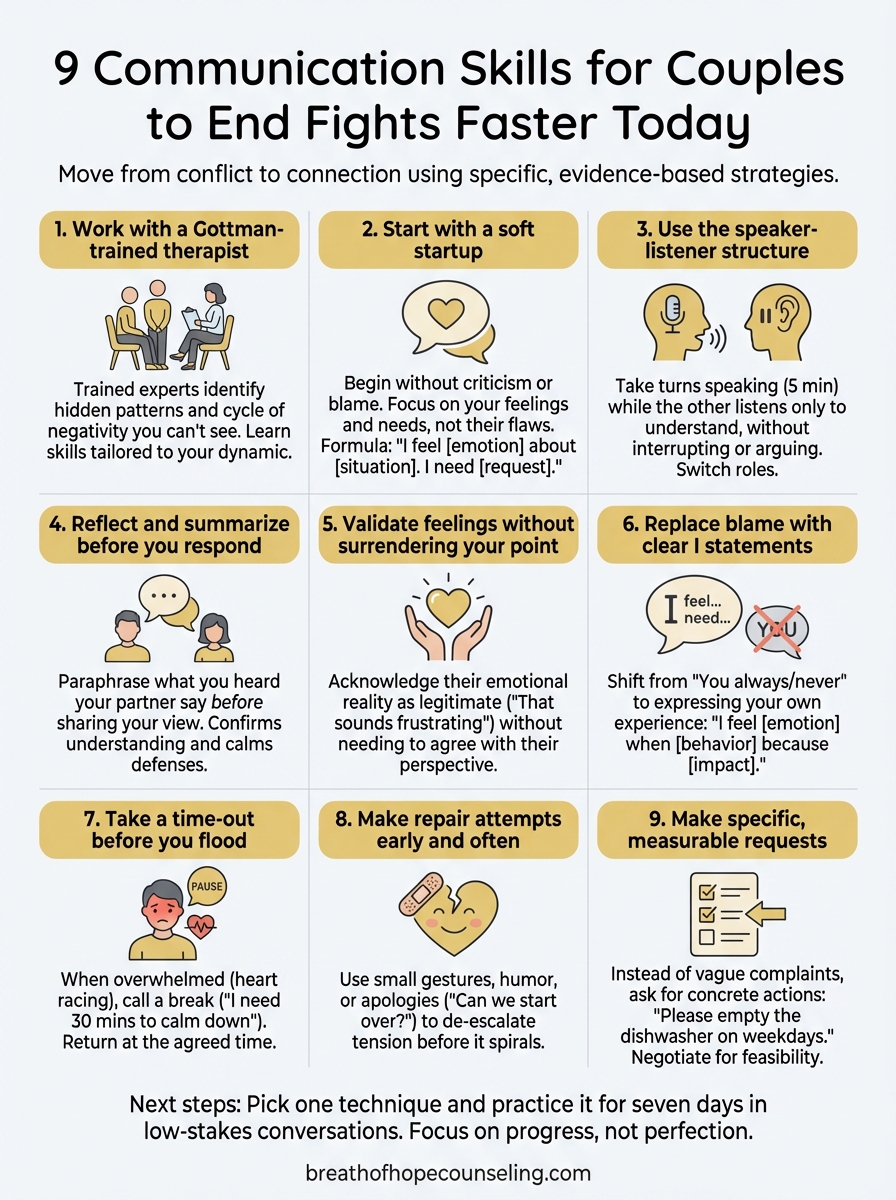
Next steps you can take this week
Pick one technique from this list and practice it for the next seven days. Don't try to master all nine at once because that overwhelms both of you and increases the chance you'll abandon everything when it gets hard. Start with whichever skill addresses your most frequent pain point, whether that's harsh startups, flooding, or vague requests that never get resolved.
Practice your chosen technique during low-stakes conversations first. You'll build muscle memory when emotions aren't running high, making the skill accessible when you need it most during actual conflict. Track what happens when you use the technique and where you still struggle.
Building strong communication skills for couples takes time and consistent effort. If you've tried these approaches and still feel stuck in the same patterns, professional support at Breath of Hope Professional Counseling can help you break through barriers you can't shift alone. Our Gottman-trained therapists work with couples throughout Texas to turn destructive cycles into productive conversations that strengthen your relationship.