

8 Therapist-Backed Ways To Improve Communication Skills
Most people think they're decent communicators, until a conflict proves otherwise. Whether it's a conversation with your partner that spirals into an argument or a work discussion that leaves everyone frustrated, poor communication creates distance where connection should exist. If you've been searching for how to improve communication skills, you're already taking the first step toward changing that pattern.
At Breath of Hope Professional Counseling, we see the consequences of communication breakdowns every day in our San Antonio practice. Couples come in feeling unheard. Individuals struggle to express their needs clearly. The good news? Communication is a skill, not a fixed trait, which means it can be learned, practiced, and strengthened with the right guidance. Our clinicians, trained in the Gottman Method and other evidence-based approaches, have witnessed firsthand how targeted communication strategies transform relationships and personal well-being.
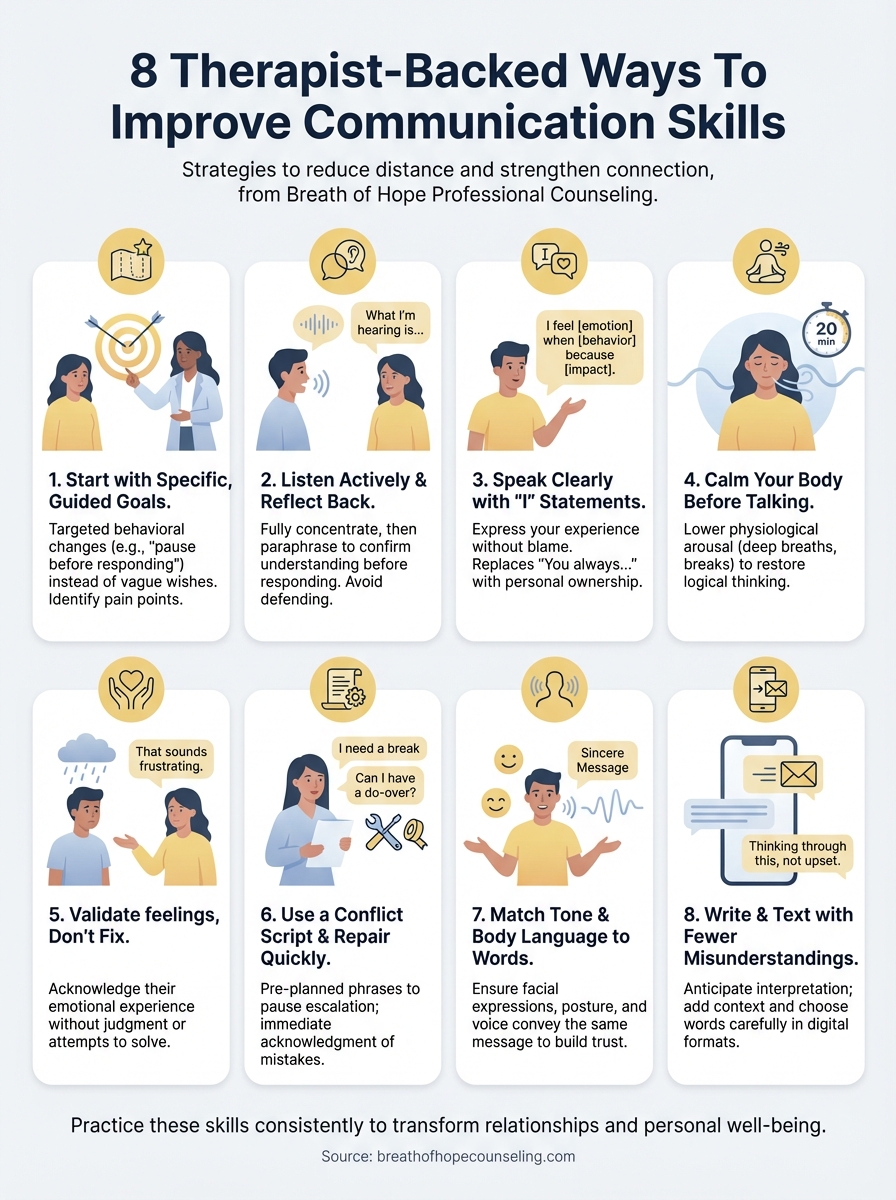
This article shares eight therapist-backed techniques that actually work. These aren't generic tips you've heard a hundred times. They're the same approaches we use in session with clients who want real results, whether you're working on expressing yourself more clearly, listening with intention, or navigating difficult conversations without things going sideways. Each strategy is practical and actionable, designed so you can start applying it today.
1. Start with therapist-guided communication goals
Before you dive into improving how you communicate, you need clarity on what you're actually trying to change. Most people skip this step and jump straight into generic advice, which is why their progress stalls. Setting specific communication goals with a therapist's framework gives you a roadmap that's tailored to your relationship patterns, not someone else's. This approach ensures you're working on what matters most, whether that's reducing defensiveness during arguments or learning to express vulnerability without shutting down.
-
Therapist-guided communication goals are targeted behavioral changes you identify with professional support. Instead of vague wishes like "communicate better," you define measurable outcomes such as "pause for three seconds before responding when I feel criticized" or "use one I-statement per difficult conversation this week." These goals address your unique communication breakdowns, informed by assessment tools and clinical observation that reveal patterns you might not see on your own.
-
Start by tracking one week of difficult conversations in a journal, noting what triggered tension and how you responded. Identify recurring themes like interrupting, withdrawing, or escalating tone. Next, choose one specific behavior you want to change and phrase it as an actionable goal. For example, instead of "be a better listener," write "maintain eye contact and wait until my partner finishes speaking before I respond." Share this goal with someone who can provide feedback, and review your progress weekly to adjust as needed.
Setting concrete communication goals transforms vague intentions into real behavioral shifts you can track and refine.
-
You can't fix everything at once. Choosing too many goals simultaneously dilutes your focus and guarantees frustration. Another trap is setting goals based on what you think you should work on rather than addressing your actual pain points in conversations. Avoid goals that depend on someone else changing their behavior first. Your communication improvements must be actions you control, not reactions you hope others will trigger less often.
-
If you've tried setting goals on your own but keep falling back into the same patterns, it's time to work with a therapist who can spot blind spots. Professional support becomes essential when communication breakdowns are damaging your relationships, when you feel stuck despite genuine effort, or when past trauma shapes how you communicate in ways you can't untangle alone. A therapist trained in evidence-based methods can help you set goals that actually address the root issues, not just surface symptoms.
2. Understanding active listening and reflection
Most arguments escalate because people talk past each other instead of actually absorbing what's being said. Active listening with reflection is one of the most powerful ways how to improve communication skills in any relationship. This technique forces you to slow down, confirm understanding, and show the other person their words actually landed. When done correctly, it defuses tension before defensiveness takes over and creates space for genuine dialogue instead of reactive exchanges.

-
Active listening with reflection means fully concentrating on what someone says and then paraphrasing it back to them before you respond with your own thoughts. You're not just waiting for your turn to speak or planning your rebuttal. Instead, you demonstrate understanding by mirroring their core message in your own words, which gives them a chance to clarify if you missed something. This builds trust and ensures you're responding to what they actually mean, not what you assumed they meant.
-
Listen without interrupting until the speaker finishes their complete thought. Then respond with "What I'm hearing is..." or "It sounds like you're saying..." followed by your summary of their main point.
Ask "Did I get that right?" to confirm accuracy. Only after they agree you understood should you share your perspective.
Repeat this cycle throughout the conversation, especially when discussing emotionally charged topics where misunderstandings multiply quickly.
Reflecting back what you heard transforms monologues into actual conversations where both people feel seen.
-
Don't add your interpretation or twist their words to fit your narrative. Reflecting isn't agreeing, so avoid defending yourself while you're supposed to be listening. Another trap is using reflection as a manipulative technique to appear like you're listening when you're really just performing. People sense inauthenticity instantly. Skip sarcastic tone or eye rolls while reflecting, which completely undermines the exercise.
-
If conversations consistently devolve into shouting matches before you can practice reflection, couples therapy at Breath of Hope can teach you this skill in a controlled environment. Professional support helps when your partner refuses to let you finish speaking, when past hurts make it impossible to listen without triggering, or when communication breakdowns require mediation to practice new patterns safely.
3. Speak with clarity using I statements
Blame shuts down conversations faster than almost anything else. When you say "You always ignore me" or "You never help around here," the other person immediately goes into defense mode instead of hearing your actual concern. Learning how to improve communication skills through I-statements replaces accusatory language with personal ownership, which creates space for understanding instead of conflict. This simple shift in phrasing reduces defensiveness and helps others hear your needs without feeling attacked.
-
I-statements are sentence structures that start with "I feel" or "I need" rather than accusations about what someone else did wrong. They express your experience and emotions without making the other person responsible for them. Instead of "You made me angry," you say "I felt frustrated when..." This approach acknowledges that your feelings belong to you while still communicating the impact of someone's actions clearly.
-
Begin with "I feel [emotion]" and name the specific feeling without judgment words. Add "when [specific behavior]" to identify what triggered the feeling. Finish with "because [impact]" to explain why it matters to you. For example: "I feel overwhelmed when dishes pile up in the sink because I value a clean space to cook dinner." Practice converting your typical complaints into this three-part structure before important conversations.
I-statements transform blame into honest self-expression that others can actually hear without getting defensive.
-
Don't disguise accusations as I-statements by saying "I feel like you're being selfish," which is still blame. Avoid vague emotions like "bad" or "upset" when more specific words like frustrated, hurt, or dismissed communicate better. Stop adding "but you..." after your I-statement, which cancels out the entire benefit of speaking from your perspective.
-
When every attempt at I-statements still triggers arguments, therapy can reveal underlying patterns preventing clear communication. Professional help matters if you struggle to identify your actual feelings, if your partner responds to I-statements with mockery or dismissal, or when past relational trauma makes vulnerability feel dangerous even with careful phrasing.
4. Calm your body before you talk
Your nervous system determines whether a conversation goes well or spirals into conflict. When your heart races, your palms sweat, or tension builds in your chest, your brain shifts into threat mode and logical thinking becomes nearly impossible. Understanding how to improve communication skills requires recognizing that your body's state directly affects your ability to listen, respond thoughtfully, and stay present. If you try to have an important conversation while physiologically flooded, you're setting yourself up for reactive behavior you'll regret later.
-
Calming your body means deliberately lowering your physiological arousal before entering a conversation that matters. Your nervous system needs to return to a baseline state where your prefrontal cortex can function properly. This involves recognizing physical signs of stress like rapid breathing, muscle tension, or elevated heart rate and using specific techniques to bring those markers down before you engage in dialogue.
-
Notice when your body shows stress signals during or before a conversation. Step away and take five slow breaths, inhaling for four counts and exhaling for six. Focus on relaxing your jaw and shoulders while breathing. Wait at least 20 minutes if you're highly activated, as your body needs time to metabolically process stress hormones. Return to the conversation only when you can think clearly and speak without your voice shaking or your words rushing out.
Physical regulation transforms your capacity to communicate from reactive to responsive.
-
Don't assume you can push through activation and stay calm through willpower alone. Skipping the cool-down period because "we need to resolve this now" guarantees worse outcomes than waiting. Avoid using substances like alcohol to calm down, which impairs judgment rather than restoring regulation.
-
If you can't calm down even with breaks, or if every conversation triggers intense physical reactions, working with a therapist at Breath of Hope can identify underlying anxiety or trauma responses. Professional support becomes necessary when your nervous system stays chronically activated, when calming techniques don't work despite consistent practice, or when past experiences make your body react before your mind catches up.
5. Validate feelings without fixing or debating
When someone shares their feelings with you, your instinct might be to solve the problem or explain why they shouldn't feel that way. This approach backfires completely. Validation acknowledges emotional experience without agreement, judgment, or attempts to change it. Mastering this skill represents one of the most powerful ways how to improve communication skills in relationships, because people need to feel heard before they can move forward.
-
Validation means recognizing and accepting someone's emotional state as real and understandable, even if you don't share that feeling or agree with their perspective. You're communicating that their experience makes sense given their context, which doesn't require you to abandon your own viewpoint. This creates emotional safety that allows deeper conversations to happen.
-
Listen to the emotion being expressed without preparing your defense. Name the feeling you hear by saying "That sounds really frustrating" or "I can see why you'd feel hurt by that." Skip the word "but" entirely, which cancels validation instantly. Stay with their emotional experience for several exchanges before introducing your perspective or problem-solving. Allow silence after validating so they can absorb feeling understood.
Validation builds trust by proving you can hold space for feelings different from your own.
-
Don't minimize emotions with phrases like "It's not that bad" or "At least you have..." which dismisses rather than validates. Avoid jumping to solutions when someone just needs acknowledgment. Stop debating whether their feeling is logical or justified, which misses the entire point of validation.
-
If validation feels impossible because you take every emotion personally, therapy at Breath of Hope can help separate your reactions from theirs. Professional guidance matters when validation attempts trigger resentment, when you can't distinguish validating from agreeing, or when relationship patterns make emotional acknowledgment feel dangerous.
6. Understanding conflict scripts and repair attempts
Arguments follow predictable patterns, which means you can prepare for them instead of reacting blindly. A conflict script gives you rehearsed language that stops escalation before it spirals out of control. Combined with quick repair attempts, this technique prevents small disagreements from becoming relationship-threatening fights. Learning how to improve communication skills includes having tools ready for moments when emotions run high and your usual thoughtfulness disappears.

-
A conflict script is pre-planned language you use during heated moments to pause, reset, or repair the conversation. These are specific phrases you've practiced beforehand, like "I need a break" or "Can we start this over?" Quick repairs are immediate acknowledgments when you mess up, such as "That came out wrong, let me try again." Both techniques interrupt destructive patterns before damage accumulates.
-
Write down three phrases you'll use when tension rises or you say something hurtful. Practice saying them out loud until they feel natural. When conflict starts, use your script immediately instead of letting the argument build. After using harsh words or tone, repair within minutes by saying "I didn't mean that the way it sounded" or asking "Can I have a do-over?"
Scripted responses and quick repairs prevent temporary frustration from becoming permanent damage.
-
Don't wait hours to repair damage, thinking "we'll talk when things calm down" without acknowledgment first. Avoid creating scripts that sound robotic or dismissive. Stop refusing to repair because "I wasn't wrong," which prioritizes being right over preserving connection.
-
If every repair attempt gets rejected or ignored, couples therapy at Breath of Hope can help rebuild trust that makes repairs possible. Professional support matters when conflicts escalate so quickly that scripts fail, when repair attempts trigger more anger, or when underlying resentment makes genuine repair feel impossible.
7. Match tone and body language to your words
Your words might say one thing while your face, posture, and voice communicate something entirely different. This mismatch creates confusion and mistrust, because people believe nonverbal cues more than spoken language when the two conflict. If you're saying "I'm fine" through clenched teeth with crossed arms, nobody believes you. Learning how to improve communication skills requires aligning your body language and tone with your actual message so people can trust what you're communicating instead of trying to decode mixed signals.
-
Matching tone and body language means ensuring your facial expressions, posture, voice pitch, and words send the same message. When you apologize, your face should show genuine regret, not irritation. When you express care, your body should lean in slightly rather than pull away. This congruence between verbal and nonverbal communication removes ambiguity that creates unnecessary conflict.
Alignment between your words and body language eliminates the confusion that fuels most communication breakdowns.
-
Before speaking, check your physical state and adjust your posture to match your intended message. Relax tension in your face and shoulders. Lower your voice volume when you want to communicate calmness, and maintain steady eye contact without staring. Record yourself during practice conversations to catch mismatches you don't notice in the moment. Ask trusted friends to point out when your tone contradicts your words.
-
Don't dismiss body language as less important than words, because listeners process nonverbal cues first. Avoid forcing fake expressions that feel performative, which people sense immediately. Stop using sarcastic tone when you claim to be sincere, which cancels your message entirely.
-
If you struggle to recognize your own facial expressions or tone patterns, therapy at Breath of Hope can provide external feedback you need. Professional support matters when trauma causes your body to communicate defensiveness even when you want connection, or when chronic tension makes neutral body language feel impossible.
8. Write and text with fewer misunderstandings
Written communication strips away tone, facial expressions, and real-time clarification, which means your texts and emails carry higher risk of misinterpretation than face-to-face conversations. You might intend a message as neutral while the recipient reads it as angry or dismissive. Mastering how to improve communication skills in digital formats prevents unnecessary conflict and builds stronger connections, especially when most professional and personal exchanges now happen through screens rather than in person.
-
Writing with fewer misunderstandings means crafting messages that communicate your actual intent without relying on context the reader doesn't have. You anticipate how your words might be interpreted differently than you meant them and adjust phrasing to reduce ambiguity. This involves choosing words carefully, providing context upfront, and recognizing when a conversation needs to move from text to voice or video.
-
Read your message aloud before sending to catch confusing phrasing or unintended harshness. Add context about your emotional state if needed, like "I'm not upset, just thinking through this." Use specific language instead of vague terms that require interpretation. When discussing sensitive topics or resolving conflict, suggest switching to a phone call rather than continuing via text where tone gets lost.
Clear written communication anticipates misinterpretation before it happens rather than repairing damage afterward.
-
Don't fire off messages when you're emotionally activated, which guarantees phrasing you'll regret. Avoid using periods after short responses, which many people read as passive-aggressive. Stop assuming the reader shares your context or mood when interpreting your words.
-
If written exchanges consistently create conflict despite careful effort, therapy at Breath of Hope can identify patterns you're missing. Professional guidance matters when text arguments trigger disproportionate emotional reactions, when you avoid written communication entirely due to past misunderstandings, or when relationship damage from digital miscommunication needs structured repair.
Next steps
Communication skills determine the quality of every relationship you have, from your partner to your coworkers to your family. The eight techniques you've learned here represent proven strategies our therapists use daily with clients at Breath of Hope Professional Counseling, but reading about them won't change anything. You need to practice these skills consistently, starting with one or two approaches that address your biggest pain points right now.
Start implementing these changes today. Pick the technique that resonates most with your current struggles and commit to using it for the next two weeks. Track what happens when you apply it during real conversations. Notice which strategies feel natural and which require more effort than you expected.
When self-directed practice isn't enough or patterns persist despite genuine effort, professional support accelerates your progress dramatically. Our clinicians in San Antonio specialize in helping individuals and couples break through communication barriers that create distance. Schedule a consultation at Breath of Hope to work with therapists trained in evidence-based methods who can identify exactly what's blocking your communication and give you personalized strategies that actually work.